How to build a $2.3B ads business
And why we left another $2B on the table
Sellers faced increasing complexity: too many decisions, limited guidance, and manual optimization.
I drove it at scale: from core campaign and reporting experiences to system-wide alignment.
Enabled millions of sellers. Established the foundation for automation and ML.
Campaign signals · Seller behavior patterns · ML recommendations · Automation paths · Next-best actions
It Began Right Where Empathy and Business Intersected

Where do I even begin?
We knew what needed to exist—but not how to build it. This wasn’t a feature or a flow. It meant redefining how millions of sellers operate.
So instead of starting small, we brought the entire system into the room—and aligned on what mattered first.
cross-functional partners
days
system
Started from outcomes—not features.
Designed the system before designing the screens.
Shared ownership by design.
Everyone had a voice—and knew what they owned.
I kept asking: are we solving the right problems?
We didn’t guess. We grounded every decision in data, system constraints, and proven industry patterns—layering evidence as we refined the hypothesis.
7+ years of seller behavior—quant and qual.
Mapped across available, emerging, and missing data services.
Deep integration with eBay’s selling platform.
Navigating legacy architecture, dependencies, and tech debt.
Aligned with industry best practicesBenchmarked against Google, Amazon, and Facebook.
Proven patterns. Familiar playbooks. Easy to believe.
It had to fit into something that already existed.
It had to integrate into a deeply interconnected—and aging—system, where every connection came with constraints.
Nothing could be introduced without affecting something else.
Seller touchpoints
Teams in real-time coordination
Regulatory variants across markets
Design systems to reconcile

The Logic
Our advertisers already knew how advertising worked—just not on eBay.
So we anchored the experience in industry-standard patterns, ensuring immediate familiarity and reducing the learning curve.
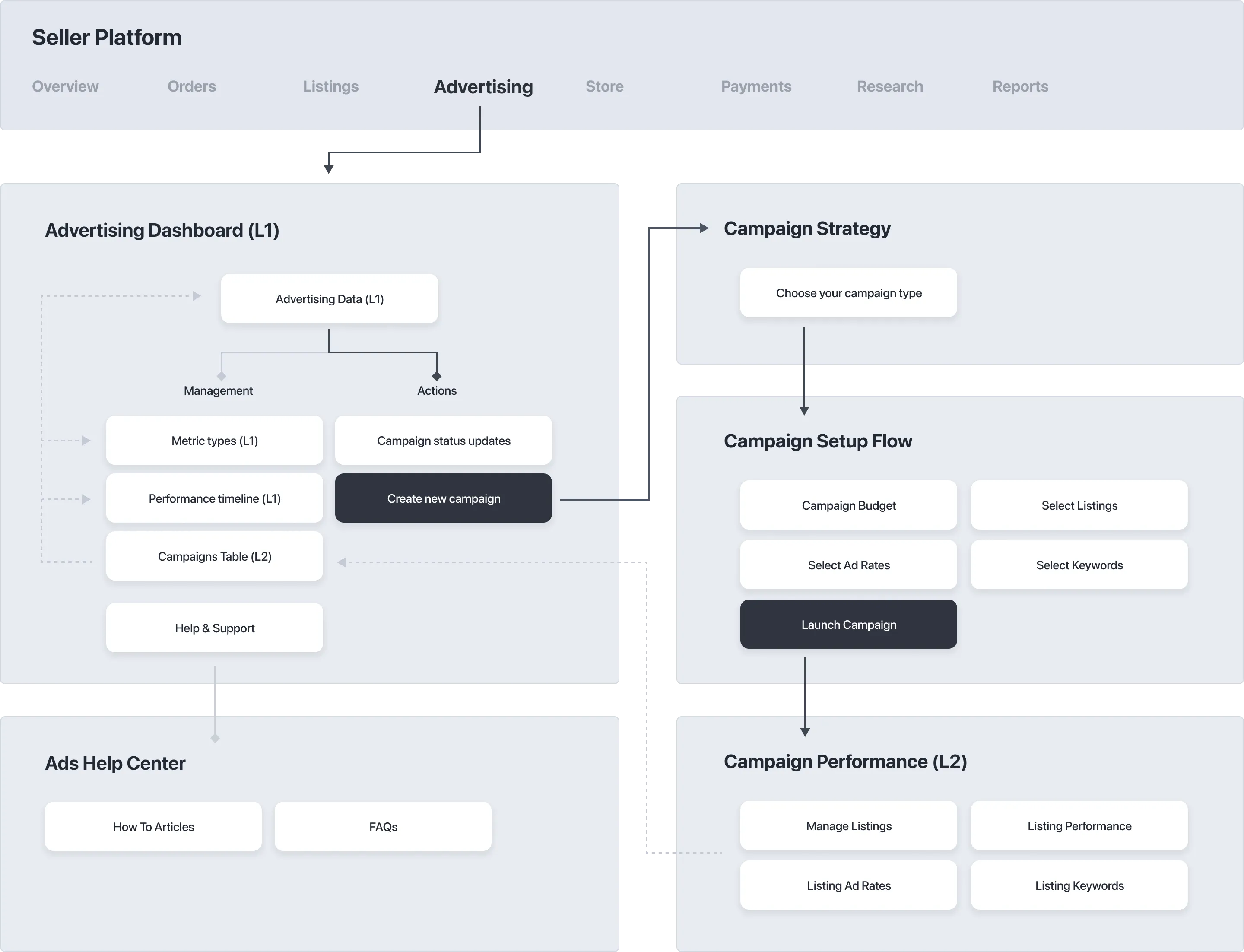
Core Experience Nodes
Advertising Dashboard
Provides a high-level view of performance across all active campaigns, including spend, impressions, and return.
Campaign Strategy
Helps sellers choose the right campaign type based on goals, inventory, and budget.

Campaign Setup Flow
Guides sellers through campaign configuration, including budget, bidding model, and listings selection.

Campaign Performance
Breaks down performance at the listing level, enabling deeper analysis across individual listings.
Dynamic Guidance (Left Rail)
Surfaces contextual signals and competitive benchmarks to inform campaign decisions during setup and optimization.
Ads Help Center
Provides educational content, best practices, and strategy resources to support campaign planning and troubleshooting.

How It All Worked Together
A unified system designed to guide sellers from insight to action.
Key surfaces of the system
Each surface was designed to move sellers from insight to action.
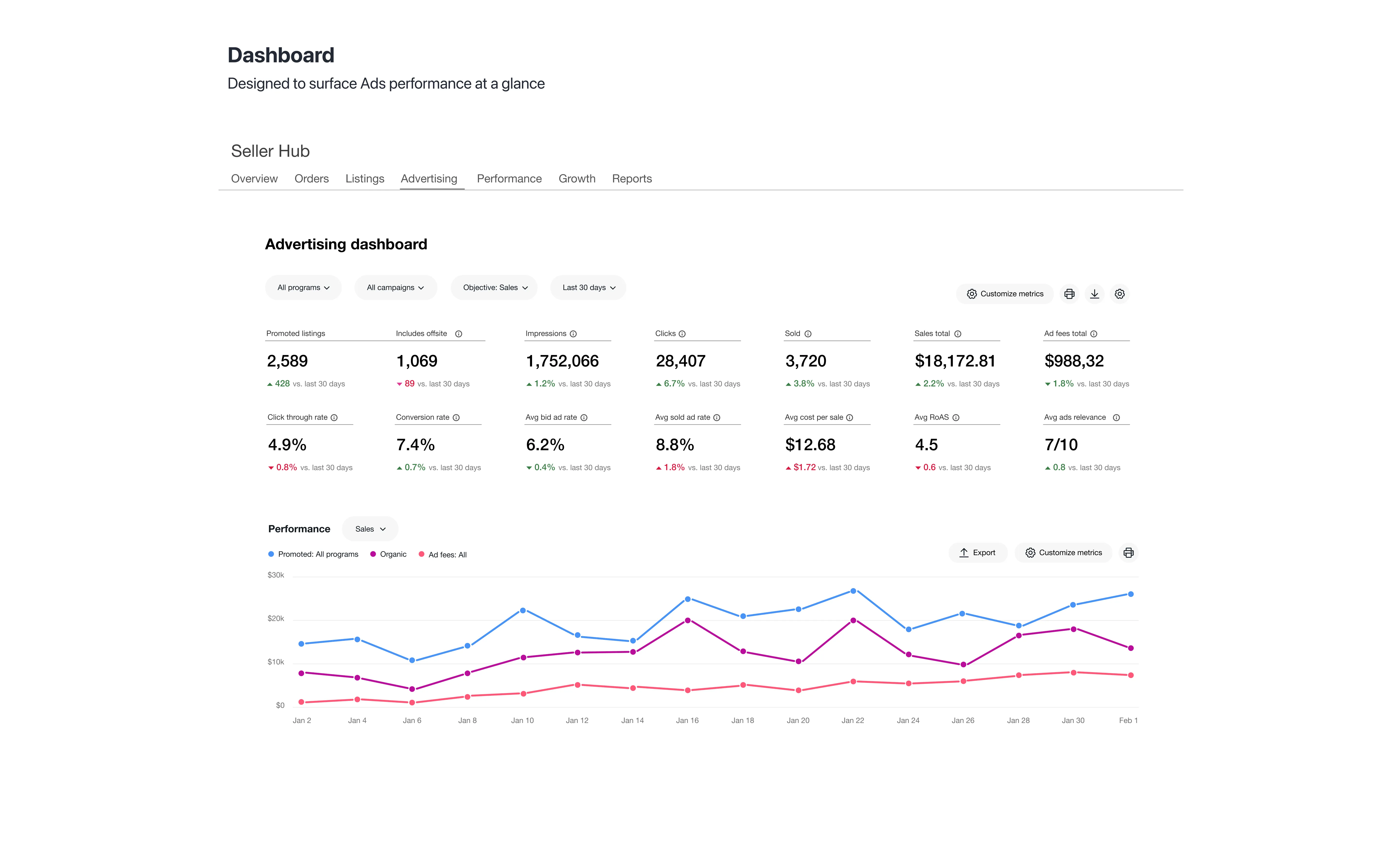
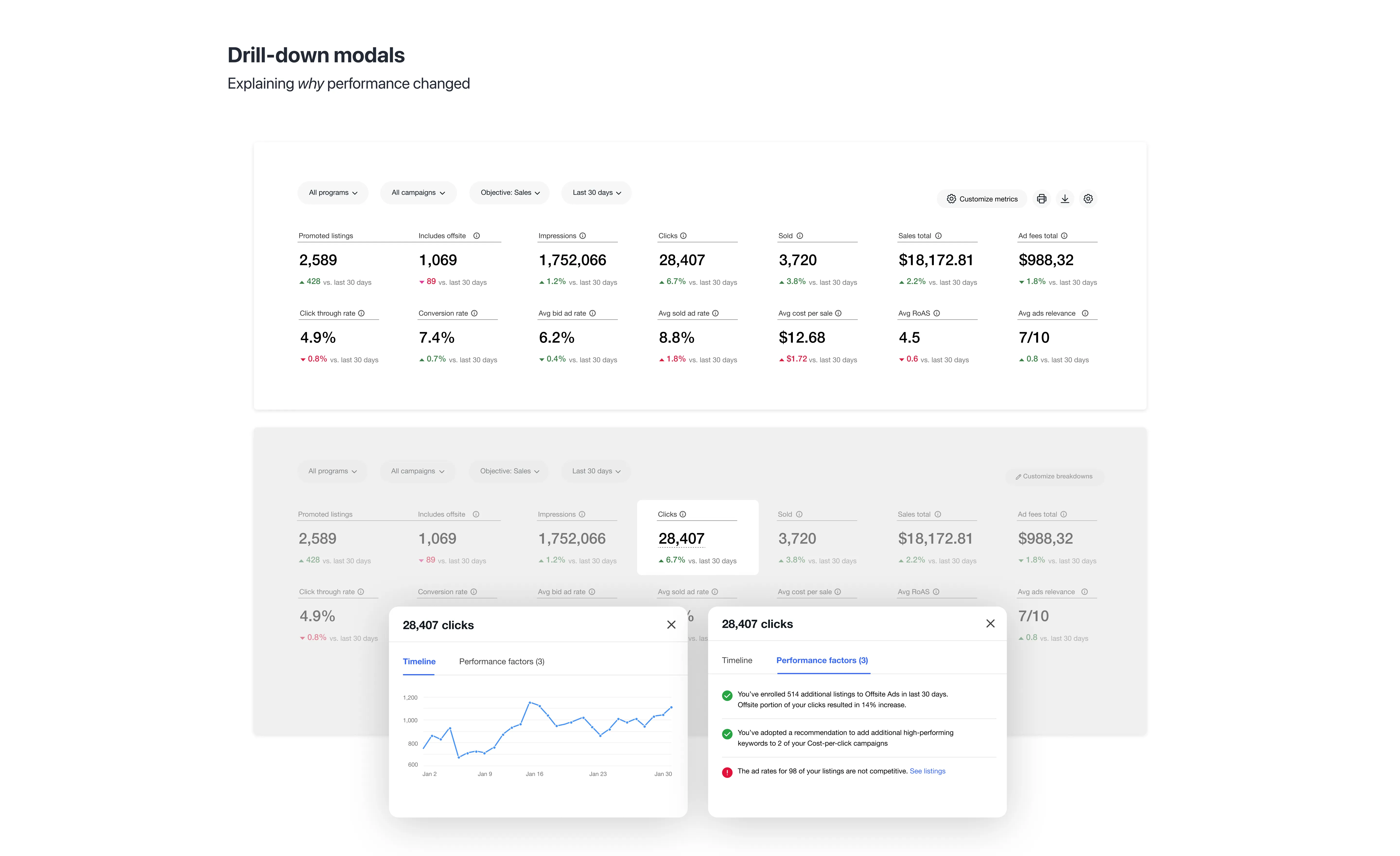
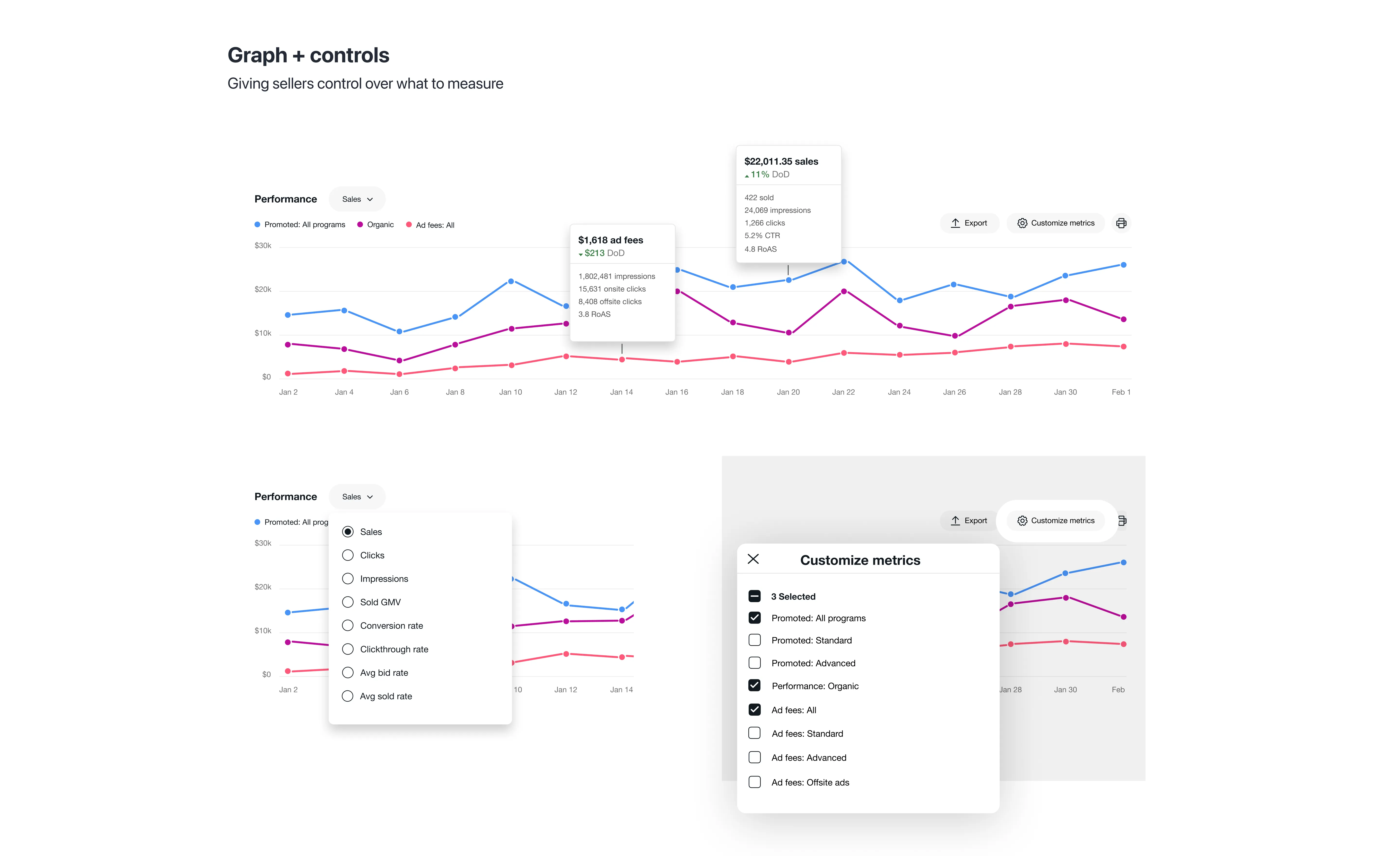
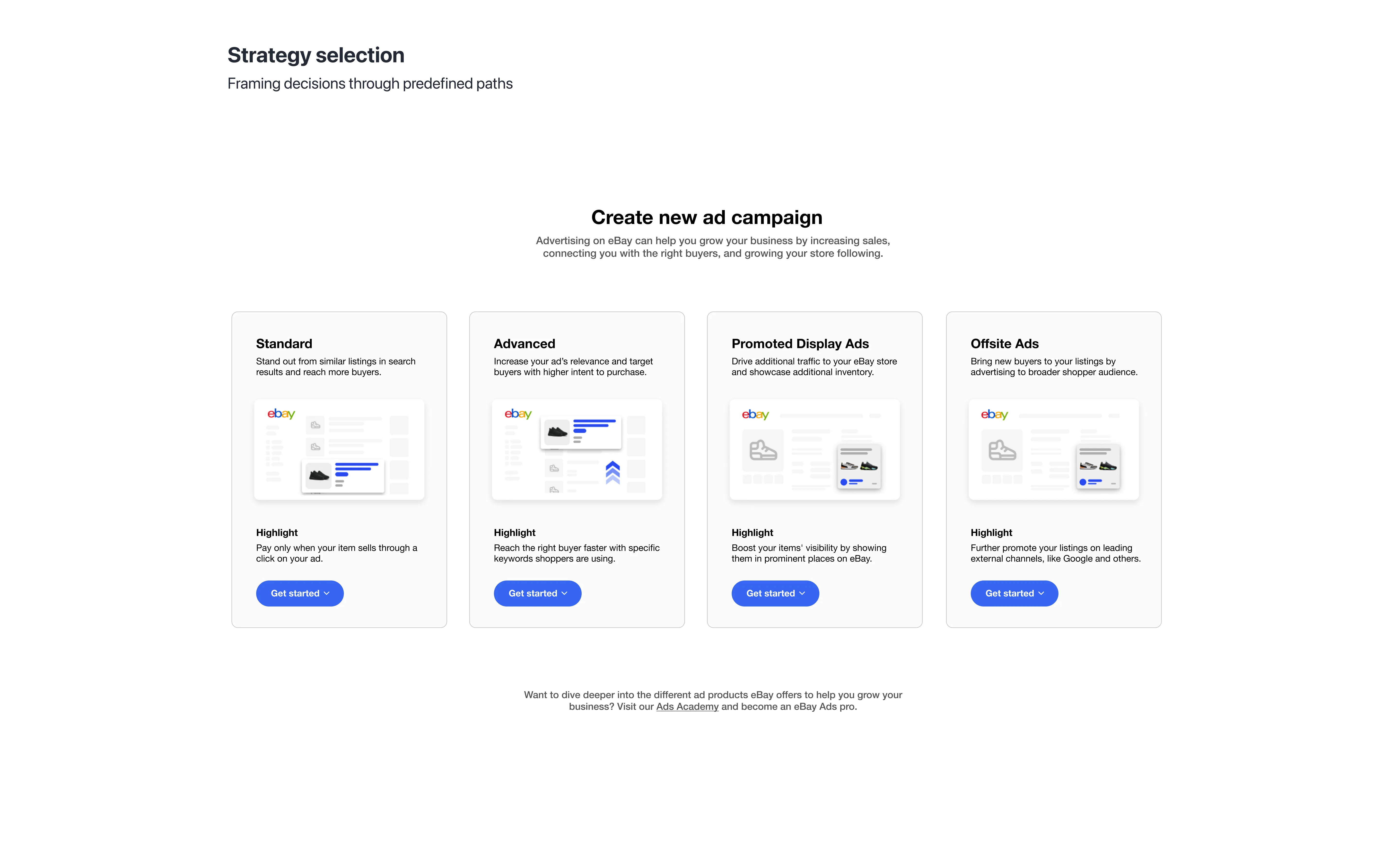
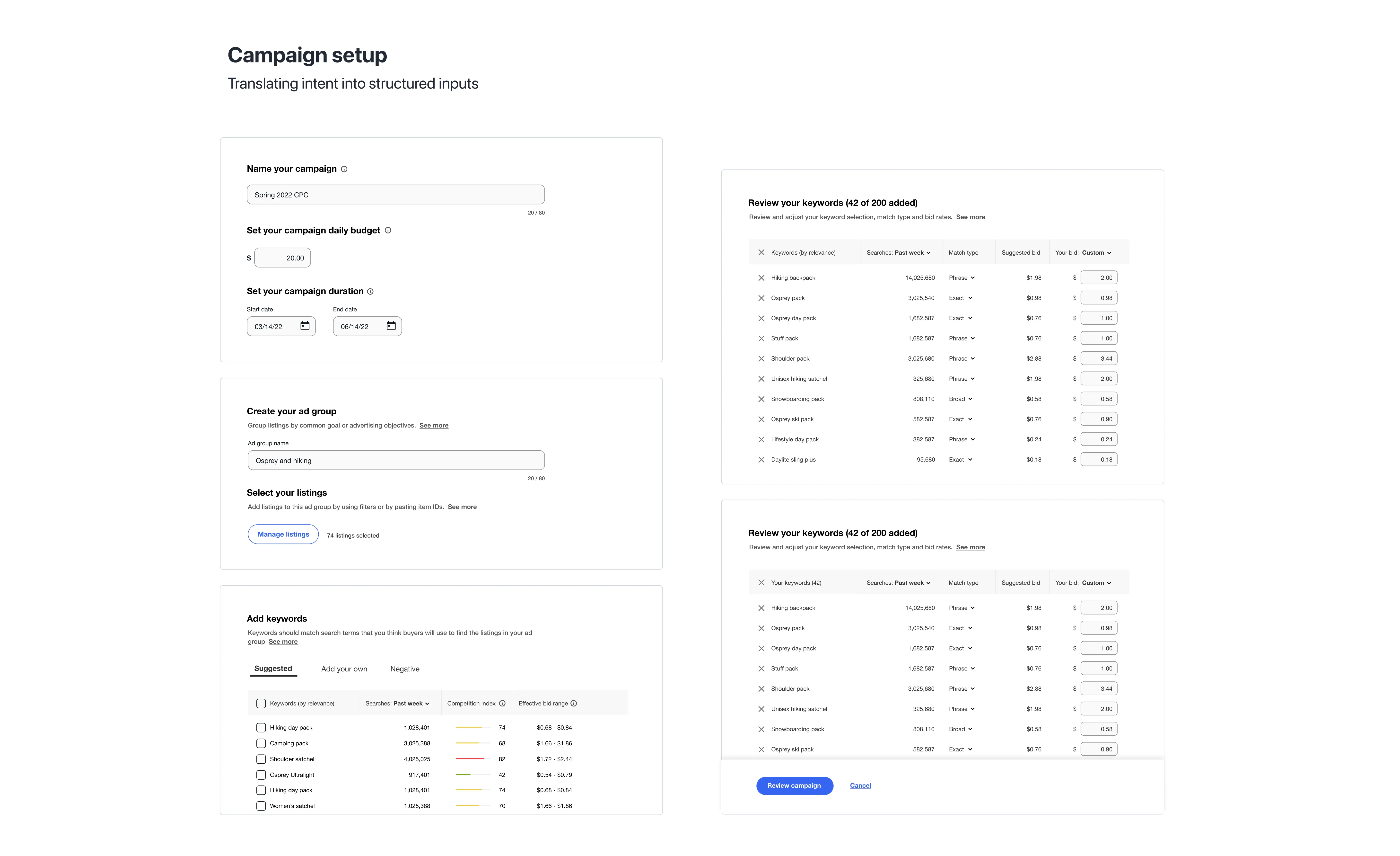
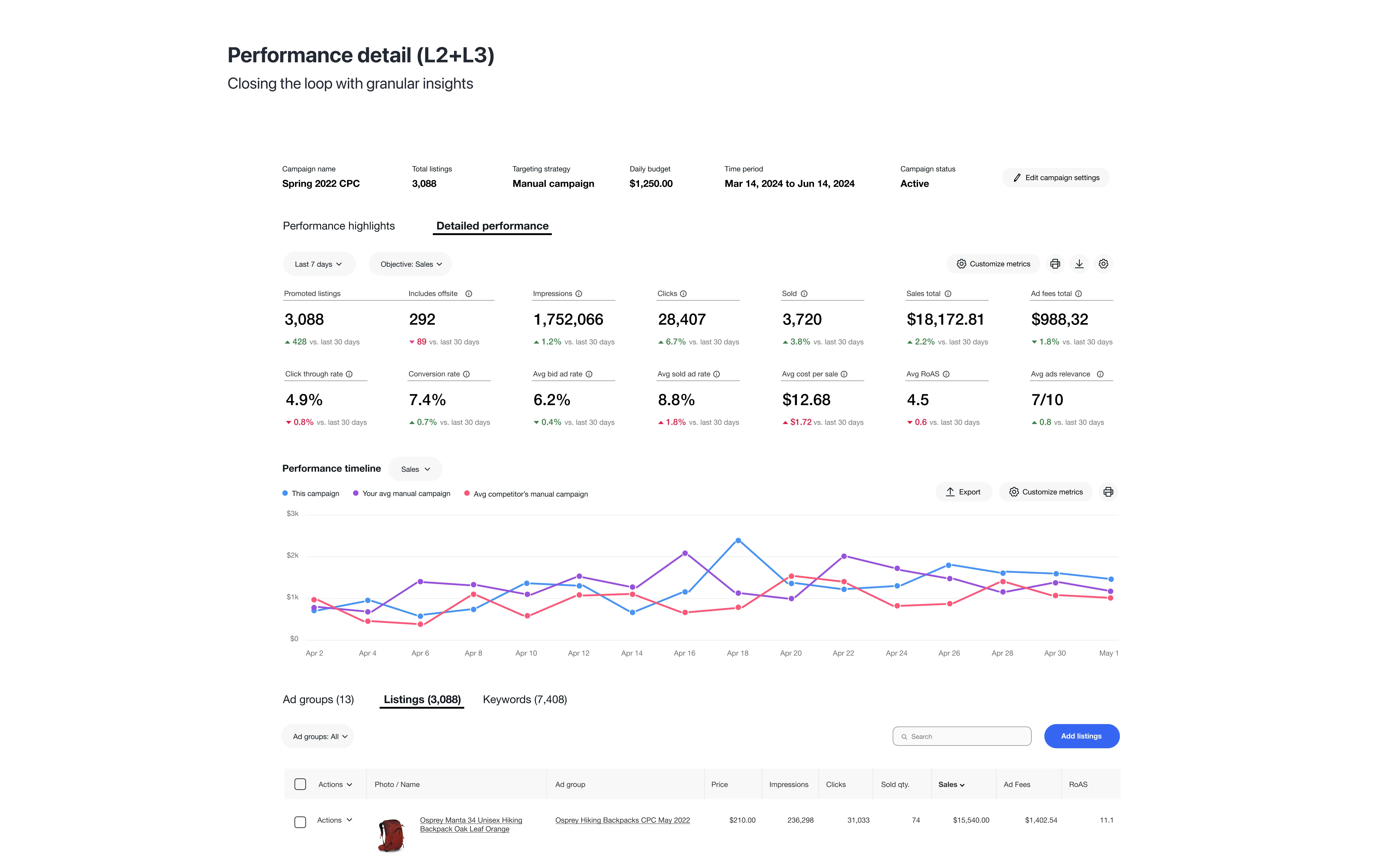
Everything was there — data, controls, guidance.
It all made sense.
We built for the most capable — not the most common
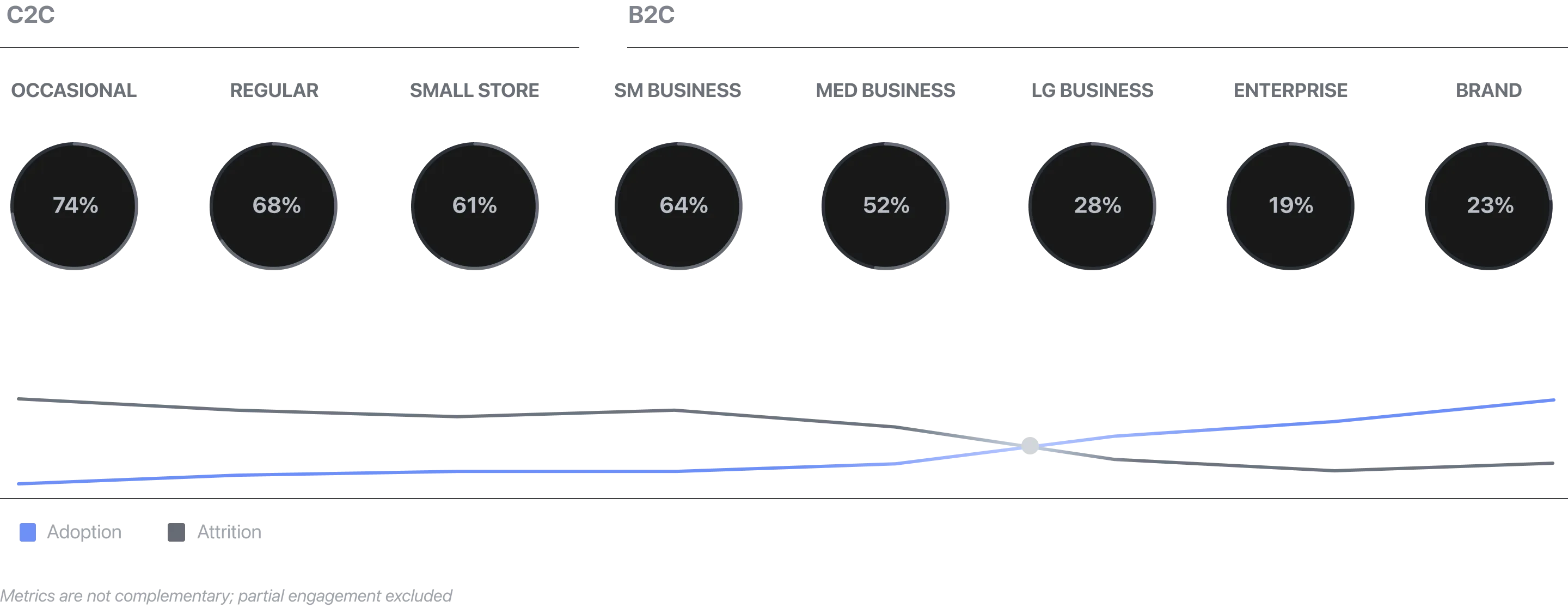
Adoption increased with seller sophistication.
Attrition did too—just in the opposite direction.
Large sellers adapted quickly.
Smaller sellers didn’t.
And smaller sellers were the majority.
~60% of sellers, ~40% of revenue
Adoption Rates across seller segments
Sustained usage within 60 days: 2+ uses within 180-day observation window

Attrition Rates across seller segments
No return within 60 days after first use
Where we lost most sellers
Post-launch behavior across seller segments
Understanding—not access—is where most sellers drop off.
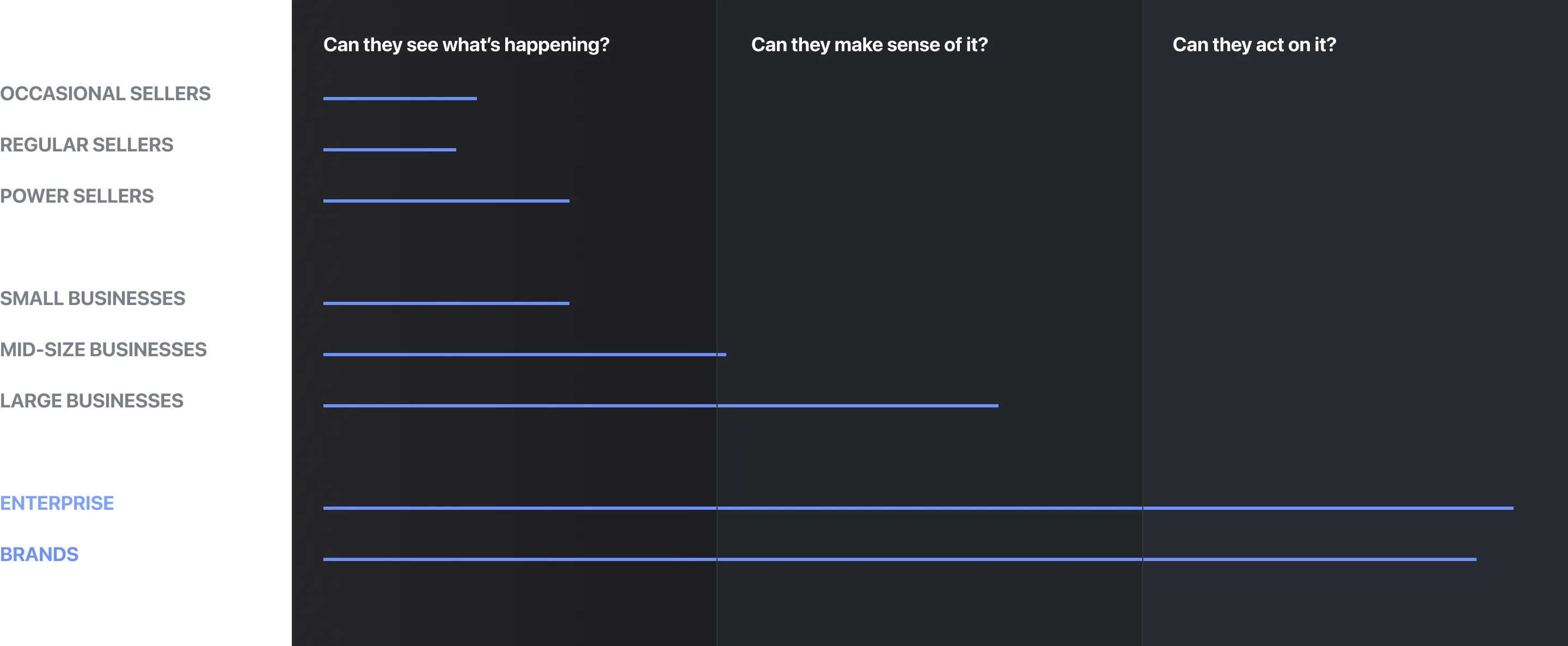
We assumed understanding.
Most sellers didn’t have it.
We delivered
Total Ads-direct revenue growth (2017-2021)
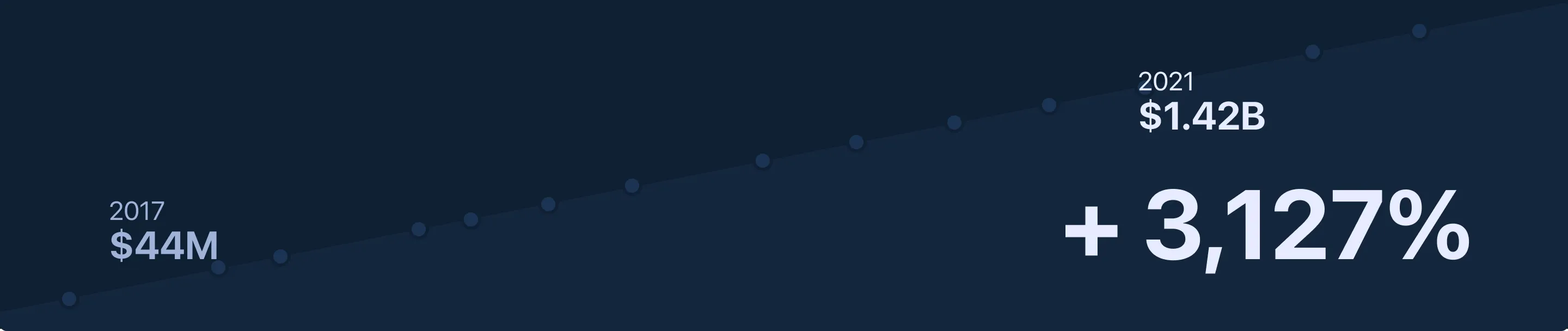
We didn’t just ship it—we operationalized it
40+ components
-25% dev time
260 hrs/month freed
~80% churn reduction
No more silos
Single XFN ownership
Sustained leadership support
More time to iterate and simplify
We built a system that worked.
But not for most sellers.
Success made change harder.
Revenue was growing. Leadership was aligned. The org was scaling around it.
The path forward felt obvious: polish, optimize, expand.
But we were leaving growth on the table.
The trap we didn’t see:
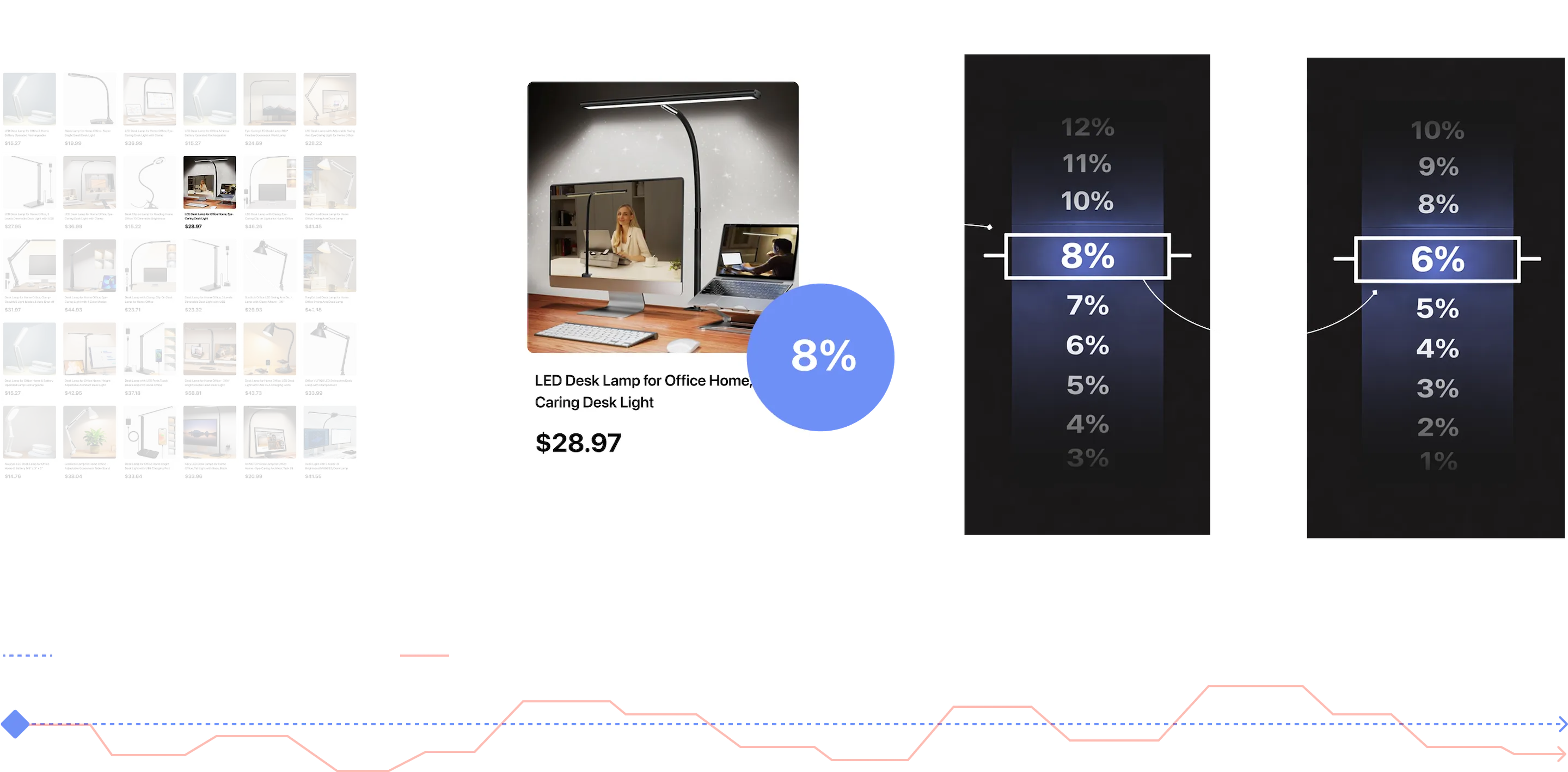
Some sellers overpaid.
Others lost visibility entirely.
The solution already existed.
An engineering team had been exploring automated rate optimization.
Early. Unproven. No production exposure.

What started as a small test became hard to ignore.
Once automation proved profitable in production, the conversation changed.
Performance improved.
Efficiency improved.
Spend remained stable.
There was no longer a reason not to move forward.
This opened the way for a new direction: automation-first advertising.
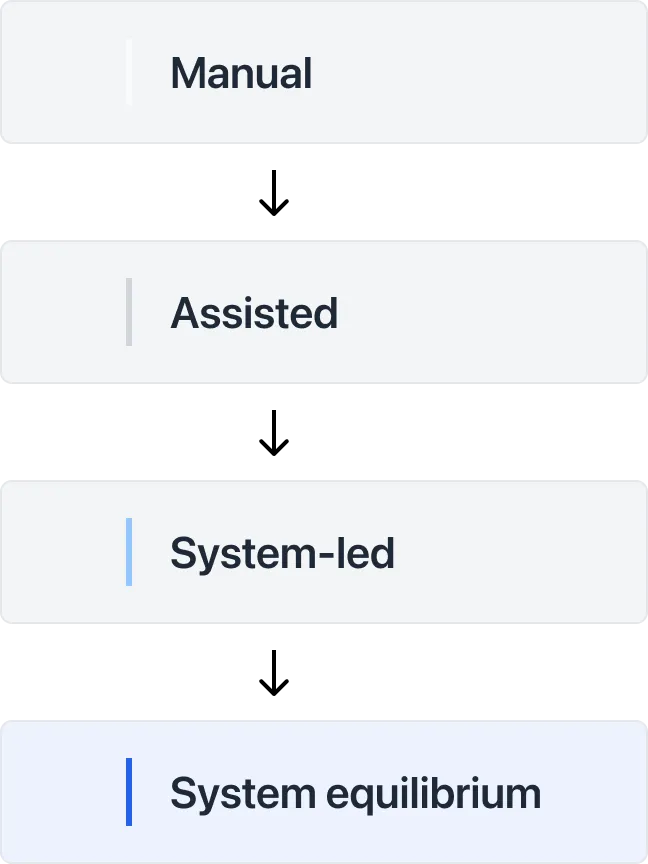
Different sellers need different levels of control.
Every minute spent analyzing data is time not spent sourcing, listing, or selling.
The real question isn’t control—it’s how much of that work they want to own vs. delegate.
Let eBay decide and act
Casual/Regular C2C sellers
Review recommendations before applying
Small B2C / Stores
Analyze and optimize everything yourself
Large B2C / Brands
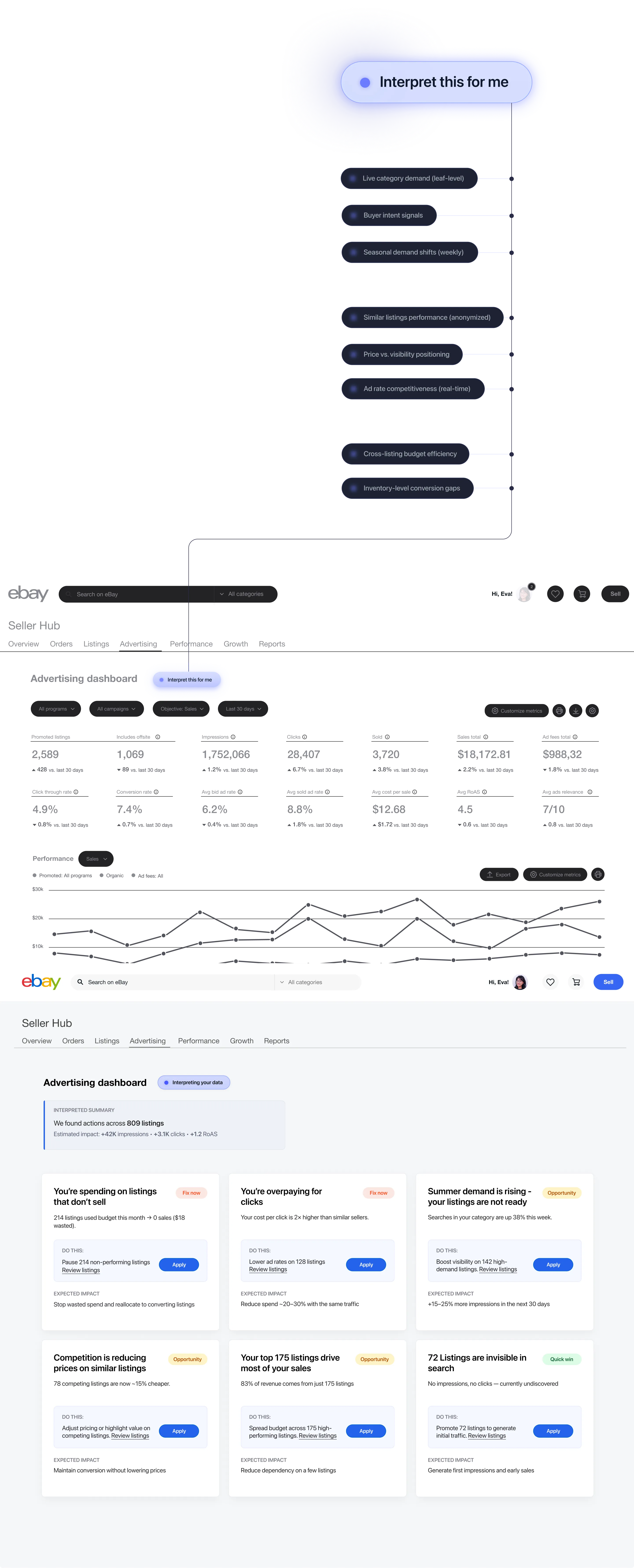
An escape hatch for sellers short on time.
The toggle was simple. The system behind it wasn’t. It combined a seller’s own performance with anonymized category signals, marketplace demand patterns, and seasonal movement — then translated that into actions a seller could actually take.
What’s gaining demand right now? We combined live category movement, buyer behavior, and seasonal shifts to identify where a seller’s inventory could capture more attention.
How competitive is this inventory in context? We translated anonymized peer performance, pricing position, and ad-rate competitiveness into guidance sellers could use without exposing any individual seller’s strategy.
Where is time and budget being lost? We looked across the seller’s own inventory to spot conversion gaps, underperforming spend, and missed opportunities to allocate attention more efficiently.
The role of AI isn’t automation.
It’s arbitration.
AI doesn’t just save time — it redistributes advantage.
In a marketplace, every optimization shifts position: visibility, pricing, demand capture. One seller’s gain is often another’s loss.
The real design challenge isn’t building better recommendations. It’s deciding how intelligence is applied across the system — who benefits, when, and by how much.
At scale, AI isn’t a feature. It becomes the market’s operating layer.
casual / small sellers
underserved sellers
entry-level ad spend
per seller
activated at ~$480/year
incremental revenue / year
Unlocking growth by removing the need for expertise.
We built a ~$2.3B ads business by serving sellers who already knew how to optimize.
The next $1–2B doesn’t come from better tools — it comes from removing the need for expertise entirely.
If even a fraction of ~10M underserved sellers adopt AI-assisted advertising, the revenue impact is measured in billions.
Not because we extracted more value — but because we made participation possible.